

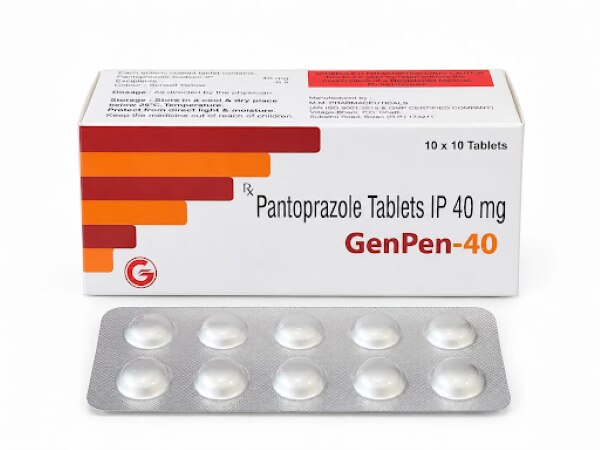
The name GENPEN-40 does not by itself confirm the tablet’s salt form, pantoprazole-equivalent strength, coating, excipients, or release performance. By checking the carton, blister, approved product information, and batch documents, you can determine what the tablet contains, how it should be taken, and whether it fits a particular manufacturing or treatment requirement.
Key takeaways
- Confirm whether 40 means pantoprazole 40 mg equivalent.
- Do not crush, chew or split the enteric-coated tablet.
- Take pantoprazole before food as directed by your clinician.
- Request the batch number, expiry date and certificate of analysis.
What Does GENPEN-40 Contain, and What Does “40” Mean?
The number 40 in GENPEN-40 does not identify the complete medicine. It commonly signals pantoprazole 40 mg on a pantoprazole-equivalent basis, not necessarily 40 mg of pantoprazole sodium or another exact salt form. Confirm the wording printed on the carton and blister instead of relying on the brand name.
For a reliable GENPEN-40 composition check, compare these records:
- Carton and blister: Confirm the active ingredient, salt form, amount per tablet, dosage form, and release description. Look for terms such as pantoprazole sodium and delayed-release, enteric-coated, or gastro-resistant tablet.
- Approved product information: Check the stated pantoprazole equivalent strength and the complete inactive-ingredient list. The 40 mg designation cannot reveal the coating, tablet-core materials, colorants, or other excipients.
- Certificate of analysis: Ask for the batch-specific result confirming identity, assay, impurities, and the approved strength basis.
The label may say “pantoprazole sodium equivalent to pantoprazole 40 mg.” That wording means the active ingredient is supplied as a salt, while the declared strength is calculated as pantoprazole equivalent strength. Do not estimate sodium content from “pantoprazole 40 mg”; calculate it from the stated salt form and excipients.
How the Enteric-Coated Tablet Protects Pantoprazole
A pantoprazole 40 mg oral tablet should be a delayed-release, gastro-resistant tablet—usually an enteric-coated tablet—not an immediate-release tablet. Pantoprazole is acid-labile: stomach acid can degrade the drug before it reaches the intestine, reducing the dose available for absorption.
The coating stays intact in gastric conditions and releases the medicine at the higher pH of the intestinal environment.
Swallow the tablet whole with water. Crushing, chewing, or splitting it can damage the coating and expose pantoprazole to acid before release. An immediate-release tablet is therefore not compositionally interchangeable with delayed-release pantoprazole, even when both state 40 mg.
For a batch review, request results for:
- Acid-stage resistance: confirms that the tablet withstands the specified acidic medium without unacceptable release or drug degradation.
- Buffer-stage dissolution: confirms release after transfer to a suitable higher-pH medium.
- Potency and uniformity of dosage units: confirms that tablets contain the intended amount and deliver consistent doses.
- Related substances: detects degradation products and other impurities.
- Coating integrity: checks defects, damaged surfaces, or uneven coverage that could cause premature release.
- Stability testing: confirms that the release profile and potency remain acceptable through the stated shelf life.
Assay alone cannot prove enteric performance; a batch can contain the right amount of pantoprazole yet fail acid-stage resistance. The approved composition and batch documents should identify the coating polymers, alkaline components, and other excipients rather than leaving the release design to inference from the brand or strength.
How to Take GENPEN-40 and Set Realistic Expectations
Take pantoprazole 30–60 minutes before food, usually before breakfast. This pantoprazole dosage timing helps the medicine act when meal-activated proton pumps are available. Follow the prescribed schedule: some patients take one dose daily, while others need a second dose before an evening meal.
- Swallow the tablet whole with water. Do not crush, chew, or split an enteric-coated or gastro-resistant tablet, because damaging its coating can expose pantoprazole to stomach acid.
- If you remember a missed dose well before the next scheduled dose, take it then.
- If the next dose is due soon, skip the missed dose and resume your normal schedule. Do not take two tablets to compensate.
Pantoprazole is not a fast rescue treatment for heartburn that has already started. The difference is PPI versus antacid: pantoprazole is a proton-pump inhibitor that reduces new acid production, while an antacid neutralizes acid already in the stomach and can feel faster.
Pantoprazole works through acid suppression, so symptom improvement may require regular dosing rather than an immediate response.
Do not increase the dose, add evening tablets, or stop treatment based only on one uncomfortable episode. Ask your prescriber or pharmacist how long to continue it and what to use for breakthrough symptoms.
Who Needs Medical Review Before Using Pantoprazole?
Unexplained weight loss, trouble swallowing, repeated vomiting, vomiting blood, black stools, chest pain, or persistent diarrhoea needs medical assessment before you treat presumed acid reflux. These pantoprazole warnings can signal bleeding, obstruction, infection, or another condition that acid suppression could mask.
| Situation | Why review is needed | What to discuss |
|---|---|---|
| Liver disease or previous PPI allergy | Clearance or hypersensitivity can change treatment safety | Dose, alternative, and monitoring |
| Low magnesium, vitamin B12 deficiency, osteoporosis, or prior fracture | Acid suppression can worsen selected deficiencies or fracture risk during prolonged treatment | Baseline risks and monitoring |
| Rilpivirine-containing treatment | Pantoprazole is contraindicated with rilpivirine in U.S. labeling because higher stomach pH can reduce absorption | Do not combine without a prescriber |
| Atazanavir or nelfinavir interactions | Reduced absorption can weaken antiviral treatment | A prescriber must choose an alternative or dosing plan |
| Warfarin, digoxin, diuretics, clopidogrel, or high-dose methotrexate | Pantoprazole can alter exposure or increase toxicity concerns | Pharmacist-led interaction review |
Ask for a medication review if you take several prescriptions, use non-prescription acid reducers, or are pregnant or breastfeeding. Do not start prolonged treatment without a documented reason and review date; ongoing use can warrant checks of magnesium, vitamin B12, fracture risk, diarrhoea, and whether the original diagnosis still fits.
Seek urgent care for black stools, blood in vomit, or severe allergic symptoms.
What Buyers Should Request Before Approving a GENPEN-40 Batch
Do not approve a GENPEN-40 batch from the words “pantoprazole 40 mg” alone. Request the approved product specification, master formula, manufacturing process, packaging specification, and certificate of analysis (CoA). The specification must state pantoprazole-equivalent strength, salt form, polymorph if applicable, enteric-coating system, storage conditions, and pack configuration.
Use this document check:
- The certificate of analysis must report assay, dosage-unit uniformity, acid-stage resistance, buffer-stage dissolution, related substances, appearance, and microbial results where applicable.
- The dissolution method must identify the apparatus, medium, time points, and dissolution acceptance criteria. Assay compliance does not prove delayed-release performance.
- Request process-validation and coating-validation summaries, plus accelerated and long-term stability data covering the proposed shelf life.
- Confirm the manufacturing licence, GMP certificate, approved product permission, batch manufacturing record, and change-control procedure.
- Check that the carton, blister artwork, prescribing information, and CoA agree on active ingredient, salt, strength, dosage form, release type, batch number, and expiry date.
| Document | What it confirms | Approval problem if absent |
|---|---|---|
| Product specification | Reproducible composition and release design | “40 mg” remains chemically ambiguous |
| CoA and test methods | Batch conformity and testable limits | Results cannot be independently assessed |
| Stability report | Shelf life and storage conditions | Potency or coating performance may drift |
| Regulatory file | Licensed, permitted manufacture | Private-label release lacks a compliance basis |
A buyer working with Genial lifecare should attach these records to the quality agreement and define notification before any formulation, supplier, site, or packaging change.
Related product
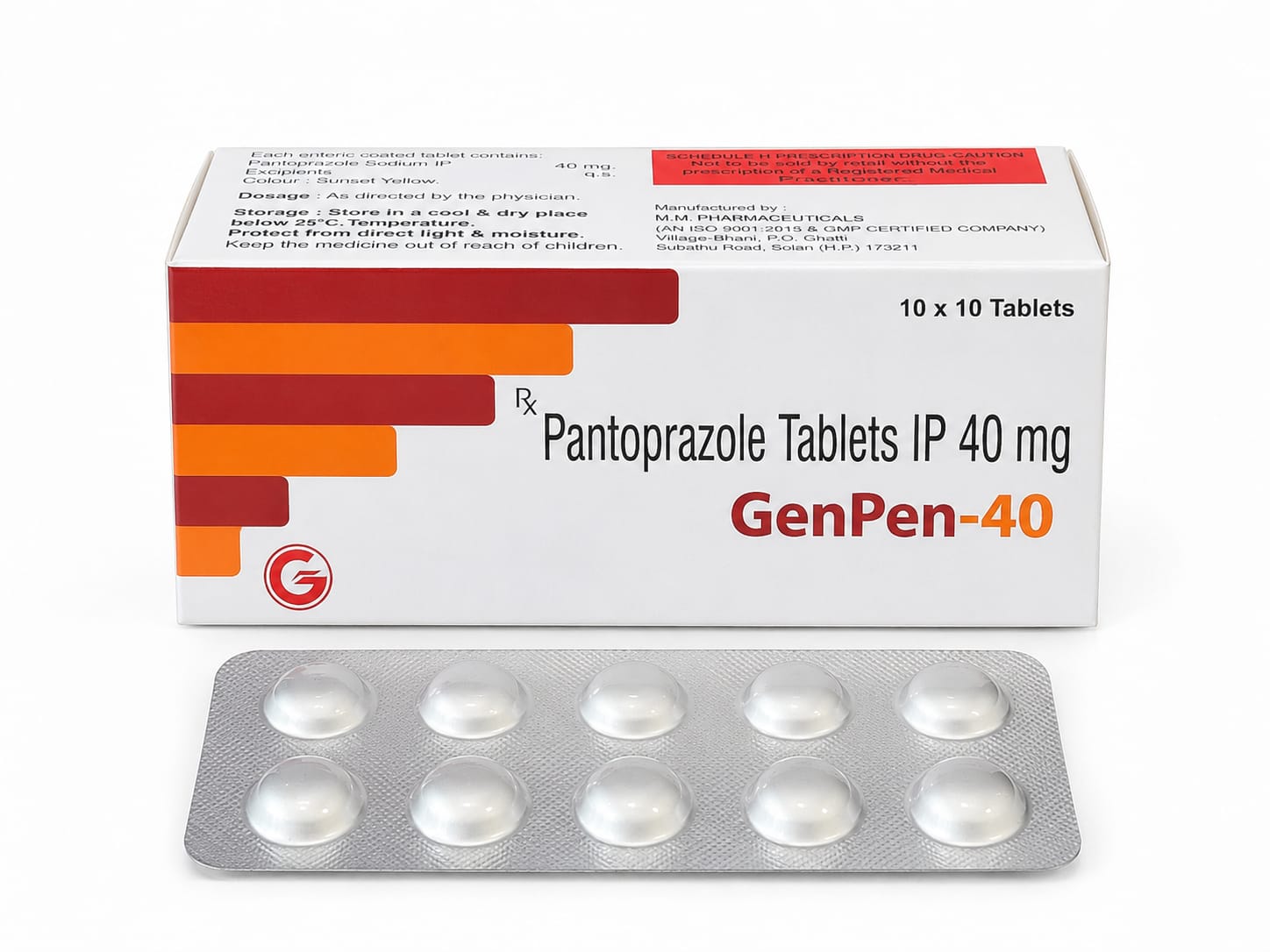 | Anti-Ulcer GenPen-40 is a Proton Pump Inhibitor (PPI) that reduces excess stomach acid production. View product → |
Frequently asked questions
What does the 40 in GENPEN-40 mean?
It commonly indicates pantoprazole 40 mg on a pantoprazole-equivalent basis. Confirm the exact salt wording on the carton and blister.
Why is GENPEN-40 enteric-coated?
The coating helps protect pantoprazole from stomach acid and releases it later in the intestine. Swallow the tablet whole rather than crushing or chewing it.
How should GENPEN-40 be taken?
Take it exactly as prescribed, usually before a meal. Do not change the dose or timing without medical advice, and set realistic expectations because symptom improvement can take time.
Who should obtain medical review before using pantoprazole?
Seek medical review if you have alarm symptoms, liver disease, a suspected medicine interaction, pregnancy or breastfeeding concerns, or symptoms that persist or recur.
What should buyers request before approving a GENPEN-40 batch?
Request the approved composition, manufacturing and expiry details, batch number, certificate of analysis, packaging records and copies of applicable manufacturing licences.