

A 200 mg capsule identifies the strength of itraconazole, not the dose every patient takes or the length of every treatment. Correct use begins with confirming the infection, matching the regimen to the body site and organism, and checking absorption, interactions, heart and liver risks, and follow-up findings.
Key takeaways
- Confirm the fungal site, likely organism, and severity before starting treatment.
- A 200 mg capsule is not a complete dosing schedule by itself.
- Follow food, acidity, interaction, and missed-dose instructions carefully.
- Seek reassessment if symptoms worsen, fail to improve, or side effects appear.
How a clinician confirms the infection and its severity
Itraconazole is appropriate only after fungal infection diagnosis establishes the organism’s likely location and severity. A clinician examines:
- The rash for scaling, borders, inflammation, and distribution
- The scalp for broken hairs, patches of hair loss, swelling, or pustules
- The mouth for removable plaques, ulcers, or deeper lesions
- The vagina for discharge, soreness, and inflamed tissue
- The nails for thickening, colour change, separation, and debris
A skin scraping examined with potassium hydroxide microscopy, or KOH microscopy, can show fungal hyphae quickly. A nail clipping fungal culture can identify the organism, while histopathology examines infected tissue and validated molecular tests help when microscopy or culture is inconclusive.
Dystrophic nails and inflammatory rashes are not automatically fungal: psoriasis, trauma, eczema, and other disorders can look similar.
Superficial infection affects the skin, hair, mouth, vagina, or nails. Invasive or systemic disease reaches deeper tissue or organs and requires a different plan.
In suspected invasive aspergillosis, the availability of a 200 mg capsule does not make itraconazole suitable; the 2016 IDSA guidance names voriconazole as usual primary therapy, with itraconazole reserved for selected alternatives or salvage situations.
Specialist assessment becomes important with recurrent, extensive, atypical, or treatment-resistant disease. Blood tests, imaging, biopsy, and organism identification help when deep infection, organ involvement, immunosuppression, or diagnostic uncertainty is present.
What dose and schedule does a 200 mg capsule represent?
A 200 mg capsule is a strength, not a universal itraconazole 200 mg dosage. The correct schedule depends on the infection, its location, nail growth, response, organism, and the product information used in your jurisdiction.
| Schedule | Product-information example | Practical meaning |
|---|---|---|
| 200 mg once daily for 7 days | Some superficial infections | One capsule per dose, once daily, for 7 days |
| 200 mg twice daily for 1 week | Onychomycosis pulse therapy | One capsule per dose, twice daily, for 7 days |
| 200 mg once daily for 12 weeks | Continuous toenail fungal infection treatment | One capsule per dose, every day for 12 consecutive weeks |
| Two 1-week pulses | Fingernail disease | 200 mg twice daily for 7 days, then 3 treatment-free weeks, followed by a second 1-week pulse |
Toenail onychomycosis can use continuous itraconazole treatment or intermittent pulses, but these are not capsule-for-capsule equivalents. The prescriber weighs the body site, suspected organism, nail growth, clinical response, interactions, and local labeling before choosing one.
Your prescription must state capsules per dose, doses per day, treatment days, and any treatment-free interval. “Itraconazole 200 mg” alone is incomplete and can lead to the wrong number of capsules or treatment days.
A systemic or invasive fungal infection requires a separate specialist-directed plan. Do not apply a superficial-infection schedule to disease involving deep tissue or organs; the drug, dose, duration, monitoring, and urgency can differ substantially.
How to take the capsule while limiting absorption and safety problems
Take itraconazole capsules after food: swallow each capsule whole immediately after a full meal. Follow the prescribed number of capsules, dosing times, treatment days, and treatment-free intervals; 200 mg is a capsule strength, not a self-selected daily dose.
1. Check absorption before changing anything. Reduced gastric acidity and itraconazole absorption are linked, so proton-pump inhibitors, H2 blockers, antacids, and other acid-reducing medicines can lower exposure. Ask the prescriber to review the specific capsule label and decide whether timing, an acidic beverage, or another strategy is appropriate.
2. Do not substitute formulations. Itraconazole oral solution is generally taken without food and can produce higher exposure than capsules. The same number of milligrams cannot be converted directly between the solution and capsule.
3. If you miss a dose, take it when remembered unless the next dose is near; then follow the label or prescriber’s instructions. Never double the next dose without medical advice.
4. Provide the complete medicine list, including supplements. Itraconazole strongly inhibits CYP3A4 and P-glycoprotein, raising exposure to some antiarrhythmics, benzodiazepines, calcium-channel blockers, statins, and immunosuppressants. It can worsen heart failure, so report breathlessness, swelling, or rapid weight gain.
5. Arrange itraconazole liver monitoring when liver disease, abnormal tests, other hepatotoxic medicines, or prolonged treatment is present. Seek urgent advice for jaundice, dark urine, severe nausea, or unusual fatigue. Discuss pregnancy before treatment; onychomycosis therapy is contraindicated during pregnancy under US capsule labeling.
Therapeutic-drug monitoring helps when absorption, toxicity, inadequate response, or prolonged therapy is a concern. For invasive aspergillosis, clinicians commonly target combined itraconazole plus hydroxyitraconazole trough exposure of at least 1 microgram/mL after steady state.
How long improvement takes and when treatment needs reassessment
Less itching, scaling, or soreness during the first few days indicates symptom relief, not microbiological cure. Continue the prescribed itraconazole treatment duration; stopping when the skin feels better can leave viable fungi behind.
Use follow-up to judge progress in this order:
1. Check the treated site against the expected timeline. Skin inflammation can take time to settle after fungal growth is controlled.
Nail clearing after antifungal treatment takes months because damaged nail must grow out; for dermatophyte nail disease, the endpoint is sustained mycological clearance plus replacement with healthy nail, not an improved surface after a few capsules.
2. Finish the prescribed course unless the prescriber changes it. Do not extend treatment because a nail still looks abnormal. Contact the prescriber promptly for jaundice, dark urine, severe nausea, unusual fatigue, breathlessness, swelling, or another serious adverse effect, rather than taking extra capsules.
3. Request reassessment if disease persists, worsens, or returns. The review should consider missed doses, poor capsule absorption, a non-dermatophyte or mixed infection, resistance, reinfection, or an incorrect diagnosis; repeat testing and drug-exposure assessment can prevent needless toxicity.
Wash and dry feet carefully, treat coexisting tinea pedis, and avoid fungal infection relapse by not sharing footwear, socks, towels, nail clippers, or files. These steps also reduce tinea pedis reinfection and contamination of newly growing nail.
What product information must accompany an itraconazole capsule
A 200 mg figure identifies capsule strength, not a universal regimen. Before supply or use, the pack, itraconazole product information, and prescribing record must match the diagnosed indication and state:
- The name itraconazole capsules, strength per capsule, dosage, treatment days, and any pulse or treatment-free interval.
- The food instruction: swallow capsules whole immediately after a full meal. Reduced gastric acidity from proton-pump inhibitors or other acid-reducing medicines requires a clinician-directed plan.
- Missed-dose advice: take the dose when remembered unless the next dose is near; do not double without medical advice.
- Contraindications and warnings, including serious CYP3A4 or P-glycoprotein interactions, heart-failure risk, liver injury, and symptoms requiring urgent review.
- Pregnancy restrictions. The US capsule label contraindicates treatment of onychomycosis during pregnancy and specifies pregnancy-avoidance precautions after treatment; other systemic infections require an individual risk–benefit decision.
- A clear statement that capsules and oral solution are not interchangeable: solution is generally taken without food and produces higher exposure, so milligram-for-milligram conversion is unsafe.
For prolonged or complex treatment, the clinical team needs a route to review every medicine, liver results, clinical response, and, when indicated, therapeutic drug monitoring itraconazole. A commonly cited invasive-aspergillosis target is a combined itraconazole-plus-hydroxyitraconazole trough of at least 1 microgram/mL after steady state is approached.
Genial lifecare or another supplier adds value when pharmaceutical formulation documentation and consistent label information prevent a capsule from being supplied without this clinical clarity; the prescriber still selects and monitors treatment.
Related product
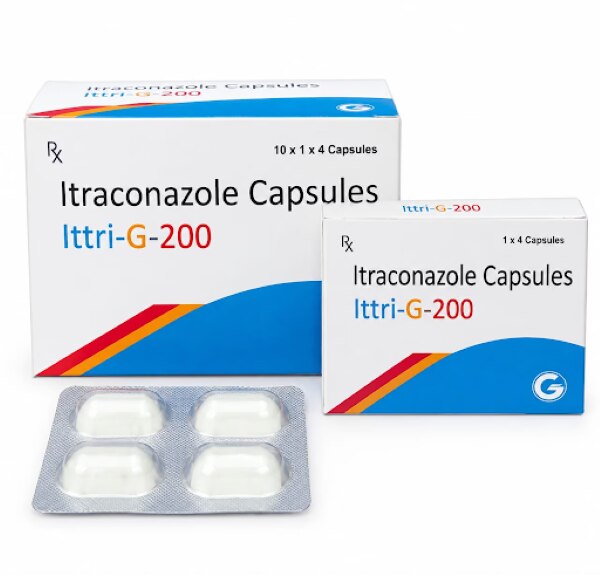
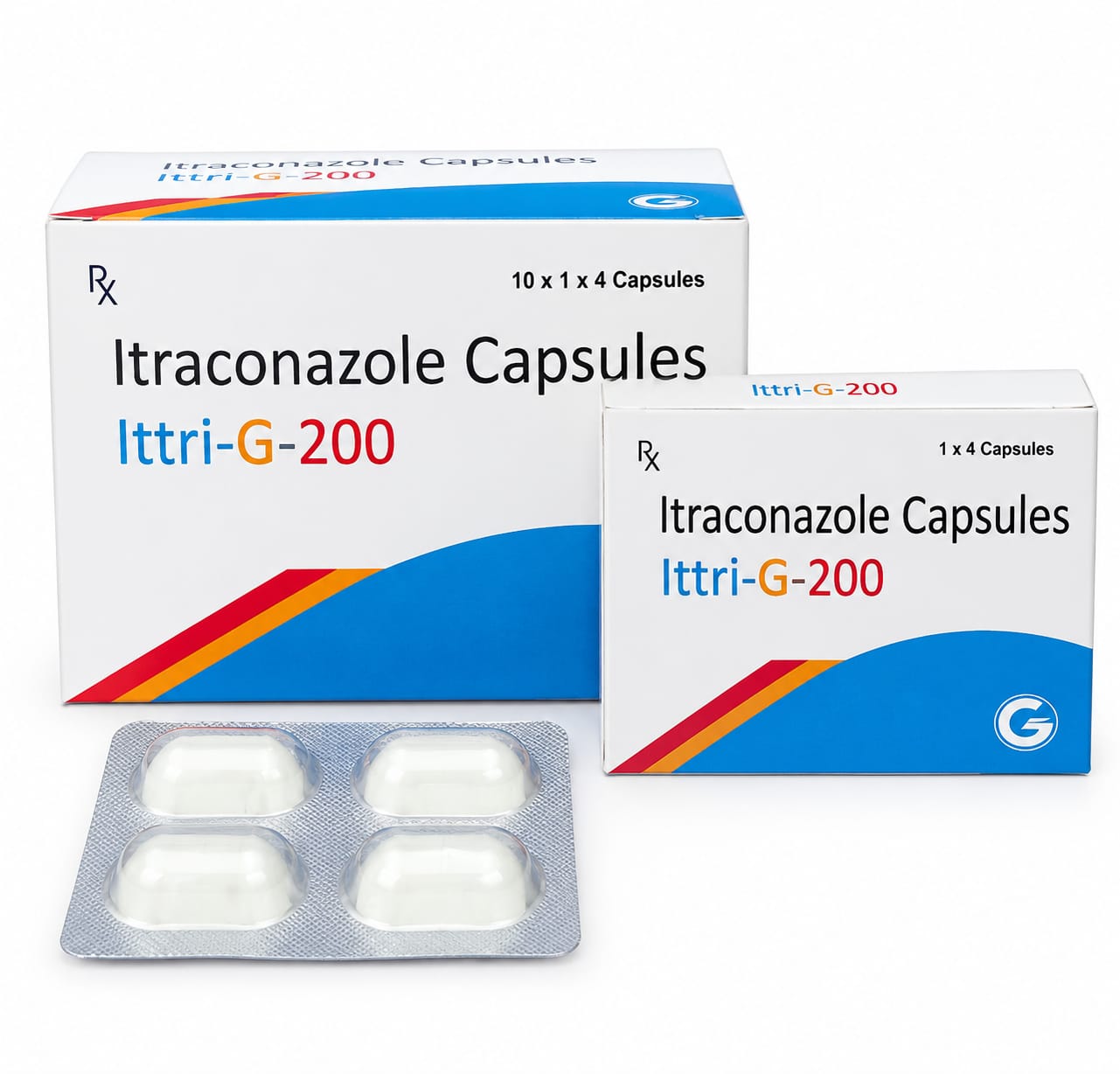 | antifungal medicine. Ittri-G-200 Capsules (Itraconazole 200mg Capsules) is a broad-spectrum antifungal medicine. View product → |
Frequently asked questions
How does a clinician confirm a fungal infection and its severity?
The clinician considers the infection’s location, symptoms, examination findings, underlying conditions, and test results such as microscopy, culture, or other laboratory testing when needed.
What does one itraconazole 200 mg capsule represent?
It represents 200 mg of itraconazole, but the prescribed number of capsules, timing, and treatment length depend on the infection and the formulation’s instructions.
How should itraconazole capsules be taken?
Swallow the capsule whole with food and follow the prescription label. Tell the clinician about acid-reducing medicines, heart medicines, and other treatments before use.
When should itraconazole treatment be reassessed?
Arrange review if symptoms worsen, fail to improve within the expected period, return after treatment, or you develop concerning effects such as breathing difficulty, severe rash, or yellowing skin.